The Framework

See the business differently.

EBUC™ treats every business unit as an accountable economic engine. Four disciplines. One operating system.

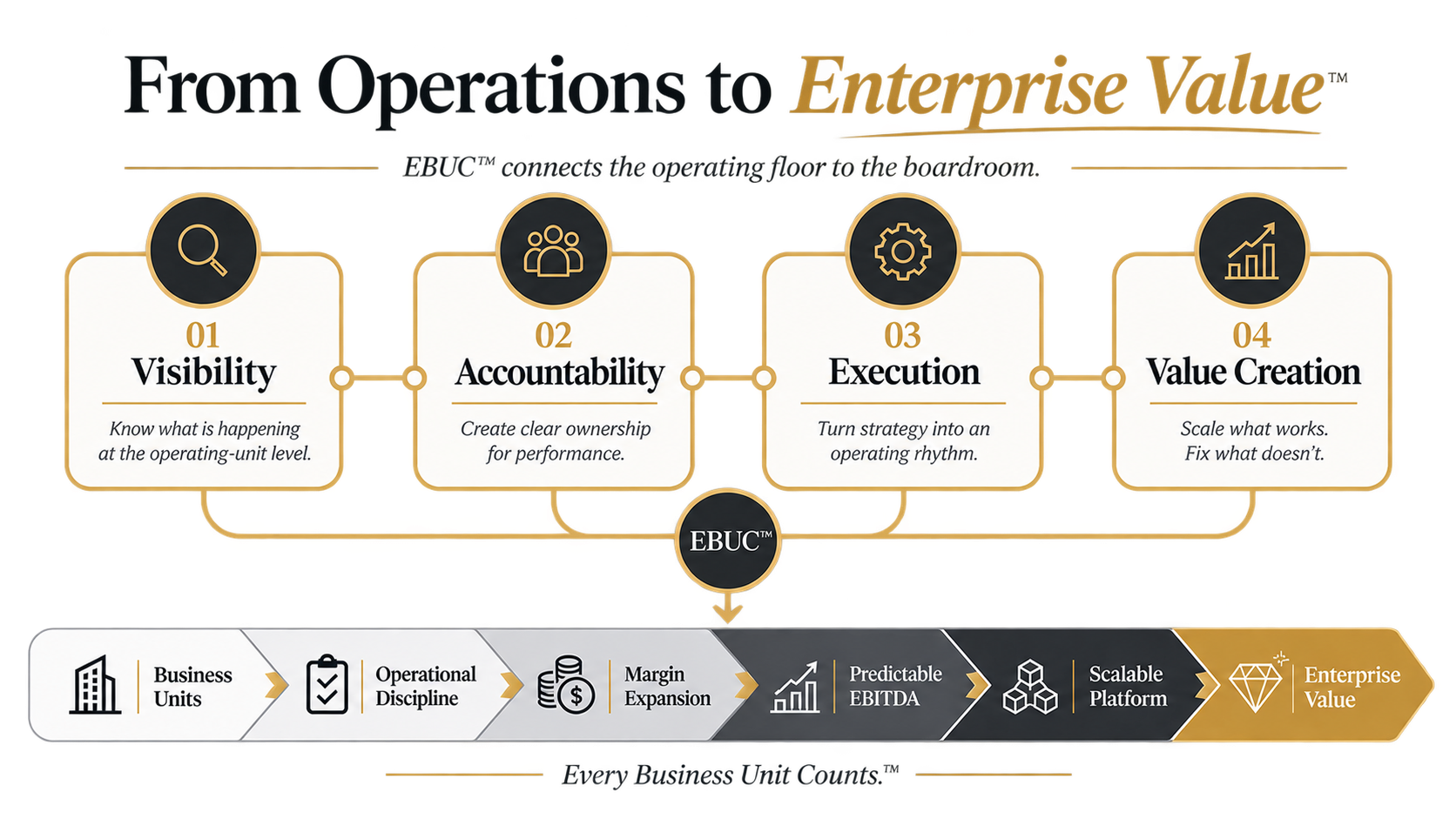
EBUC™ framework diagram — From Operations to Enterprise Value, showing the four pillars: Visibility, Accountability, Execution, and Value Creation

From Operations to Enterprise Value

Enterprise value is created one business unit at a time.

In multi-location, infrastructure and field-service businesses, consolidated results can hide the real story. EBUC™ pushes accountability to the operating level — where customers are served, resources are deployed, margins are created and execution actually happens.

01

Visibility

Know what is happening at the operating-unit level.

You cannot manage what you cannot measure. EBUC™ starts by establishing clear, consistent visibility into the metrics that actually drive performance at the unit level — not just the consolidated view that masks what is working and what is not.

You cannot improve what you cannot see.

Key metrics

Revenue

Top-line performance by unit, market and customer segment.

Gross margin

The spread between revenue and direct cost of delivery.

Utilization

How effectively assets, equipment and crews are deployed.

Labor productivity

Output per labor hour across operating units.

Pricing

Realized price versus target and market rate.

Customer mix

Revenue concentration, contract quality and customer profitability.

Cash conversion

Speed of converting revenue into collected cash.

02

Accountability

Create clear ownership for performance.

Accountability is not a culture initiative. It is a structural discipline. Every business unit has measurable expectations, defined operating priorities and a leader who owns the outcome. There is no hiding inside consolidated results.

No hiding inside consolidated results.

Key metrics

Measurable expectations

Explicit targets at the unit level — not just company-wide goals.

Operating priorities

The two or three things each unit must execute on in the current period.

Accountable leadership

Named owners for every unit's performance, with no ambiguity.

Operating cadence

Regular rhythm of review, feedback and course correction.

Consequence clarity

Clear understanding of what performance means for the leader and the unit.

03

Execution

Turn strategy into an operating rhythm.

Strategy has no value until it reaches the field. EBUC™ translates high-level direction into specific operating disciplines that unit leaders can act on every day — pricing decisions, workforce deployment, customer management and cost control.

Strategy becomes valuable when it reaches the field.

Key metrics

Pricing discipline

Consistent application of pricing strategy at the point of sale.

Asset utilization

Maximizing productive use of equipment, vehicles and infrastructure.

Workforce productivity

Scheduling, deployment and performance management at the crew level.

Customer execution

Delivering on commitments and managing the customer relationship.

Cost control

Managing direct and indirect costs within the unit's control.

Capital allocation

Directing investment toward the highest-return opportunities.

04

Value Creation

Scale what works. Fix what doesn't.

When individual operating units improve consistently, the entire platform becomes stronger, more predictable and more scalable. EBUC™ connects unit-level performance directly to EBITDA quality and enterprise value — making the link between daily operations and the boardroom explicit.

Business Unit Performance → EBITDA Quality → Enterprise Value

Key metrics

EBITDA quality

Recurring, defensible earnings versus one-time or fragile contributions.

Platform scalability

The ability to add units, markets or volume without proportional cost increases.

Earnings predictability

Consistency and visibility of future performance.

Multiple expansion

The valuation premium earned by high-quality, predictable operating businesses.

Exit readiness

The operational and financial profile that commands premium valuations.

The Operating Logic

Execution → Accountability → Performance → Enterprise Value

Each discipline builds on the last. Visibility without accountability produces reports. Accountability without execution produces plans. Execution without value creation produces activity. EBUC™ connects all four into a single operating system.

Ready to apply the framework?